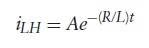
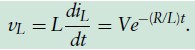
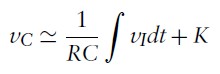
State variable allows us to solve transient problem by superposition
Total response is the sum of the zero-input-response (ZIR) and the zero-state-response (ZSR)
The particular solution and the homogeneous solution are terms which apply to a method of solving differential equations
Zero-input and zero-state responses arise from a particular way of partitioning the circuit problem into two simpler subproblems. The resulting subcircuits can be solved by finding the homogeneous solution and particular solution in each case.
One advantage of state equation formulation is that even in the nonlinear case, the equations can be readily solved on a computer
The value of state variable at time t + dt can be estimated by standard numerical method ie. Euler's method:
The value of vC at time t = t + 2dt can be determined in like manner from the value of vC(t0+dt) and i(t0+dt) . Subsequent value of vC can be determined in same process
By choosing small value of dt, a computer can determine the waveform of vC(t) to a certain degree of accuracy
This process illustrates the fact that the initial state contains all the information that is necessary to determine the entire future behavior of the system from the initial state and subsequent input
This procedure works even for circuits with many capacitors and inductors, linear or nonlinear, because these higher-order circuits can be formulated in term of a set of first order state equations, one for each energy storage element ( with an independent state variable) in the network
Analysis of capacitor and inductor circuits based on their state/memory aspect is used when the circuit is non-linear or contains a large number of storage elements
Voltage as a state variable:
All of the relevant past history of the circuit prior to t1 is summarized in one value, q(t1)
Variables that have this property are called state variables
If we know the value of state variable at one time, and the value of input variable thereafter, we can find the value of the state variable for any subsequent time
The first order differential equations for RC and RL circuits can be written as:
To find vc(t), we must solve a non-homogeneous, linear first-order ordinary differential equation with constant coefficients:
To solve this equation, we will use the method of homogeneous and particular solutions because this method can be readily extended to higher order equations
The method states that the solution to the non-homogeneous differential equation can be obtained by summing together the homogeneous solution and the particular solution
Total solution (vCH(t) is called the homogeneous solution and vCP(t) is called the particular solution)
When dealing with circuit responses, the homogeneous solution is also called the natural response of the circuit because it depends only on the internal energy storage properties of the circuit and not on external inputs. The particular solution is also called the forced response or the forced solution because it depends on the external inputs to the circuit.
The root of the characteristic equation, s, is also called the natural frequency of the system.